

News //
Written by Professor Peter Ng
Remembering a gentleman scientist and a friend–Gathorne, Earl of Cranbook (1933-2026)
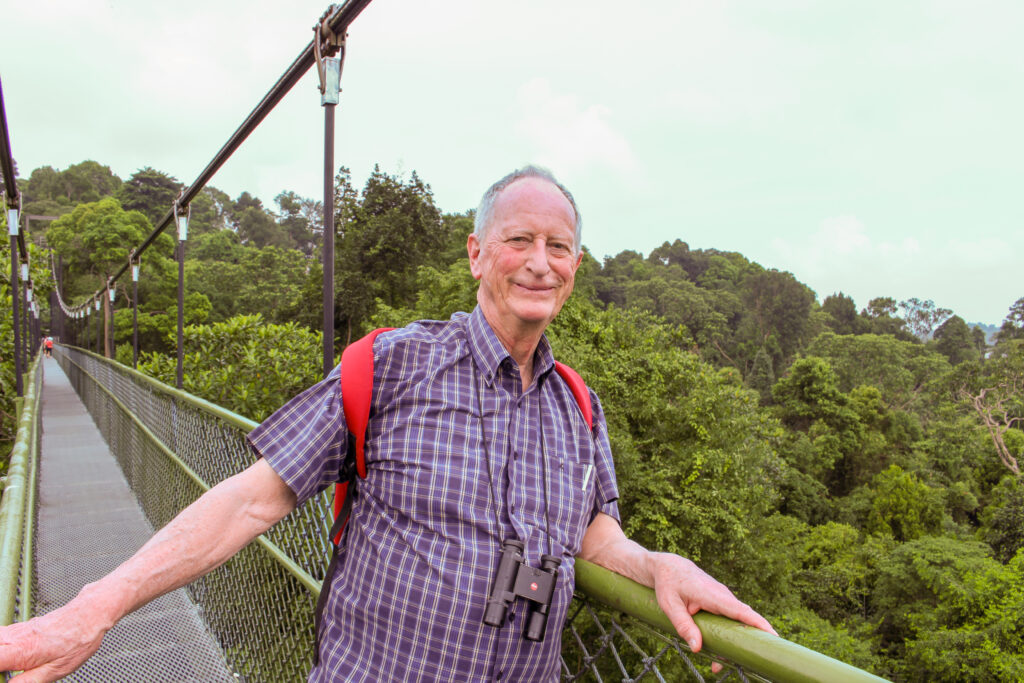
We live in an age where ‘innocence’ is a word we rarely use and one that is becoming increasingly redundant. But there was a time, just a few generations ago, when science was an innocent adventure and a scientist could be a scholar and a gentleman—innocently hunting down the mysteries of nature. I knew a man who lived and epitomised these halcyon times. That man passed on several days ago at the age of 93… Colleagues knew him as Lord Medway or the 5th Earl of Cranbrook… We know him as Gathorne. Gathorne was a dear friend.
A lifetime ago, in the mid-1980s, as a young man starting his long academic career, I received a letter from Gathorne asking if I would be willing to pen a chapter on freshwater crabs for a book he and Jose Furtado were putting together titled ‘Key Environments: Malaysia’. I gathered that Gathorne’s old collaborator in the University of Malaya, Yong Hoi Sen had told him there was this crazy graduate student chasing down these animals in Malaysia and may be able to say something about them. My reaction was “Wow! A Lord has asked me to help!” And that is how I first came to know this man from the upper echelons of English society. And yes, I did the job he asked of me (Ng, 1988). In those days, to receive a letter with the crest from the English House of Lords (he is the Earl of Cranbrook after all!) was so cool. Yet, Gathorne never fussed about his status. He never put on airs, and he was as easy to talk to as my next-door-neighbour—ever enthusiastic, ever energetic, and always curious about everything! Over the ensuing decades, as I chased crabs throughout Malaya and Sarawak, I encountered the name ‘Earl of Cranbrook’ everywhere I went. I met people who had worked with him in Gombak (he established the research station there), in Mulu (he was the driver for the first scientific expedition there), in Serian (he had led archaeological studies there), finding his name on labels with crab specimens he collected all over Sarawak, as well as unending kudos from innumerable people who have studied under him, worked with him, hunted and explored with him, and otherwise interacted with him. I always enjoyed corresponding with him, and even more chatting with him when we met in Kuala Lumpur or Kuching during meetings, or when he visited me at the old Raffles Museum and later the Lee Kong Chian Natural History Museum (LKCNHM). He was a treasure house of information and a wise man of natural history.
I remember I was once at the Natural History Museum in London examining crab specimens (I think it was in 2012) when my old friend, Paul Clark, who is the curator for crustaceans there, picked up a call, then came over to me looking very serious and remarked: “Pete—the Lord is waiting for you over in Geology—you have to go—now!”. It was Gathorne, of course. He had found out I was in London and wanted me to see some recent fossils that had been dug up from Jambusan Caves in the Bau area in Sarawak by A. H. Everett in 1878– 1879. He was studying the archaeology of the caves and had this bag of unidentified crab claws that no one could identify. He wagered I could, and luckily for me, I did. And from this, I have the proud distinction of co-authoring a very nice paper with Gathorne on these crab claws! It was fun for me and a pleasure working with him (Ng & Earl of Cranbrook, 2014).
In 2000, I was elected to the International Commission for Zoological Nomenclature (ICZN), and as fate would have it, Gathorne became the chairman of the International Trust for Zoological Nomenclature in 2001. The Trust, long based at the Natural History Museum in London, was the body tasked to manage the commission’s finances. For seven years, he helped obtain large sums of money to keep the Secretariat of the ICZN afloat—a thankless job at the best of times. This funding was necessary to ensure the ICZN functioned to take care of the myriads of nomenclatural problems faced by zoologists from around the world. He was always a strong supporter of the ICZN, fully cognisant of its value for the zoological world. He even helped the ICZN launch the necessary ZOOBANK in preparation for the digital age (Polaszek et al., 2005). One conversation I had with him at the end of his tenure stayed with me. He lamented on the never-ending search for money to keep the Secretariat afloat and said that the ICZN had to find a more sustainable financial model to keep itself afloat, and that the ICZN had to adapt. As a globalist, he was never locked into the idea that the ICZN had to stay in the UK so he asked if Singapore could do something and if need be, take over? He said that the commissioners (myself included) had to do something as he was not young anymore. Losing Gathorne as a ‘financial godfather’ in 2008 was a reality check—and as expected, the Trust ran out of money. That compelled the ICZN senior management team to take drastic action. The ICZN eventually built an endowment in Singapore linked to LKCNHM. Today, the Secretariat resides at the National University of Singapore, after migrating from London 10 years ago. During a visit to the Museum in 2013, he gave me a wry smile and noted that what he had hoped for was realised. He was happy that by letting go, he had helped the Commission grow up.
In 2012, his ex-disciples Geoffrey Davison with Lena Chan, both of whom were with the National Parks Board in Singapore, broached the idea to me of a valedictory volume for Gathorne for his 80th birthday. It was an excellent idea, and I volunteered the Raffles Bulletin of Zoology as the organ of publication. Gathorne had published it in its earlier reincarnation (the Bulletin of the National Museum of Singapore) in the 1960s (as Lord Medway), so it was most appropriate. With help from his friends, Geoffrey Davison, David Wells and Yong Hoi Sen put together a wonderful tome with dozens of papers in 2013 to honour the man (Davison et al., 2013a). On that occasion, I proudly named a beautiful cave crab with long elegant legs from a cave in Serian, Sarawak with a long archaeological history after him—Stygothelphusa cranbrooki (Ng, 2013).
Gathorne is a man of infinite energy, patience and with a diversity of interests that is startling. His accomplishments and commitments to natural history,science and conservation have spanned almost his whole adult life and have been very well documented by Davison et al. (2013b) and by his family recently (Anonymous, 2026). He lived a very good life—he lived many lives. And he lived them very well. He will be missed—but his legacy will surely endure. That I am confident. Goodbye, Gathorne.
Peter K L Ng
Advisor
Lee Kong Chian Natural History Museum
National University of Singapore
References
Anonymous, 2026. Obituary. Gathorne Gathorne-Hardy, 5th Earl of Cranbrook (1933 – 2026). The Malayan Nature Journal, 2026.
Davison G W H, Wells D R & Yong H S (2013a) (editors) Special Volume in Honour of the 80th Birthday Gathorne Gathorne-Hardy 5th Earl of Cranbrook. Raffles Bulletin of Zoology, Supplement 29: 1–280.
Davison G W H, Yong H S & Wells D R (2013b) Cranbrook At Eighty: his contributions so far. Ornithologist, mammalogist, zooarchaeologist, chartered biologist and naturalist. Raffles Bulletin of Zoology, Supplement 29: 1–7.
Ng, P K L, 1988. Freshwaters ‑ Decapod Crustaceans, by Earl of Cranbrook & J. I. Furtado. In: Key Environments: Malaysia. Pp. 225–250. Editor: Earl of Cranbrook. Pergamon Press, Oxford pp. 225–250.
Ng, P K L, 2013. Stygothelphusa cranbrooki, a new species of cave crab from Gua Sireh, Sarawak, Malaysia (Crustacea: Decapoda: Brachyura: Gecarcinucidae). Raffles Bulletin of Zoology, Supplement 29: 91–97.
Ng, P K L & Earl of Cranbrook, 2014. Fossil brachyuran crabs from the Jambusan Caves (Bau, Sarawak), collected by A H Everett in 1878-1879. In: Fraaije, R H B, M. Hyžný, J WM. Jagt, M Krobicki & B W M Van Bakel (eds.), Proceedings of the 5th Symposium on Mesozoic and Cenozoic Decapod Crustaceans, Krakow, Poland, 2013: A tribute to Pál Mihály Müller. Scripta Geologica, 147: 289–307, 1 table, 5 plates.
Polaszek, A, D Agosti, M Alonso-Zarazaga, G Becalloni, P de Place Bjørn, P Bouchet, D J Brothers, Earl of Cranbrook, N Evenhuis, H C J Godfray, N F Johnson, F-Th Krell, D Lipscomb, C H C Lyal, G Mace, S Mawatari, S E Miller, A Minelli, S Morris, P K L Ng, D J Patterson, R L Pyle, J Taverne, J van Tol, Q D Wheeler & E O Wilson, 2005. Commentary: A universal register for animal names. Nature, 437: 477.