
On 26 May 2026, the Museum will be closed from 10 AM to 12 PM. Admission resumes from 1 PM onwards. On 29 May 2026, the Museum will also be closed at 2 PM. Last admission will be at 1pm.
The History of the Javan myna in Singapore

The History of the Javan myna in Singapore

If you take a stroll through a housing estate in Singapore, pause at a nearby coffeeshop, or glance up at a roadside tree, you are almost guaranteed to encounter a medium-sized bird with a sleek black body, a yellow beak and black feet. The Javan myna ( is one of Singapore’s most ubiquitous birds today, but did you know that a hundred years ago, this bird was hardly seen in the wild here?
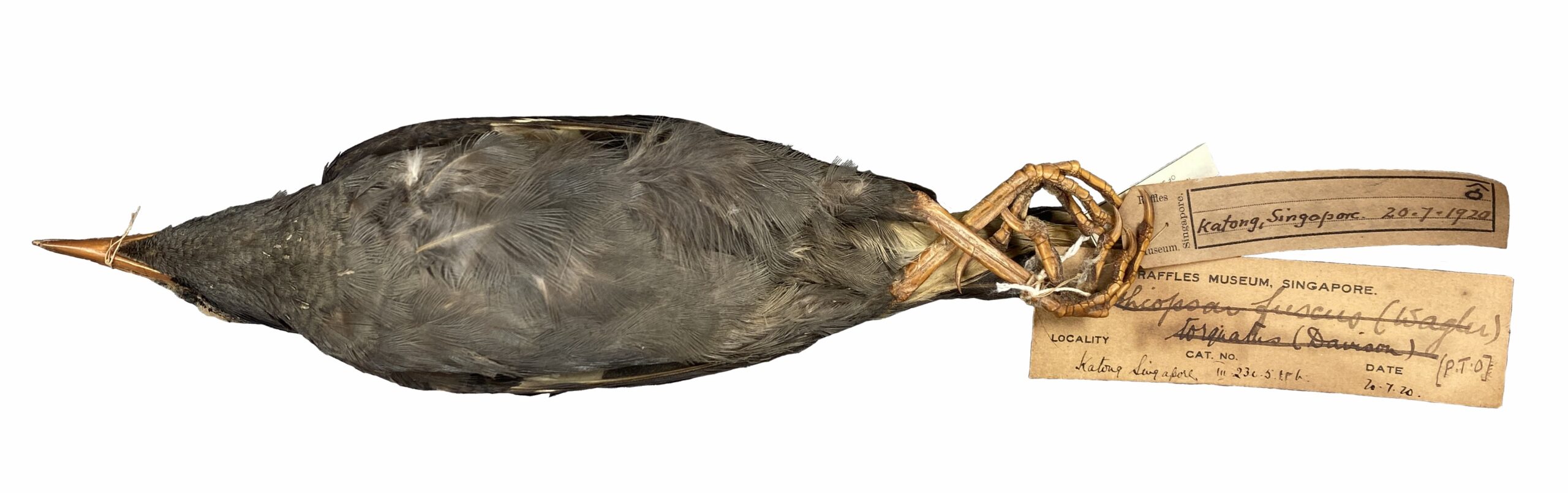
Javan myna specimen collected from Katong, Singapore on 20 July 1920 (Credit: Kathy Poh, Lee Kong Chian Natural History Museum).

The oldest Javan myna specimen in the Lee Kong Chian Natural History Museum’s collections was collected from Katong on 20 July 1920. According to Frederick Nutter Chasen’s Birds of Singapore Island (1925), they were probably first brought in from Java as part of the caged bird trade. The Javan myna was likely coveted then because of its skill in vocal mimicry. Both this specimen and this published text are some of the earliest known records of the Javan myna in Singapore!
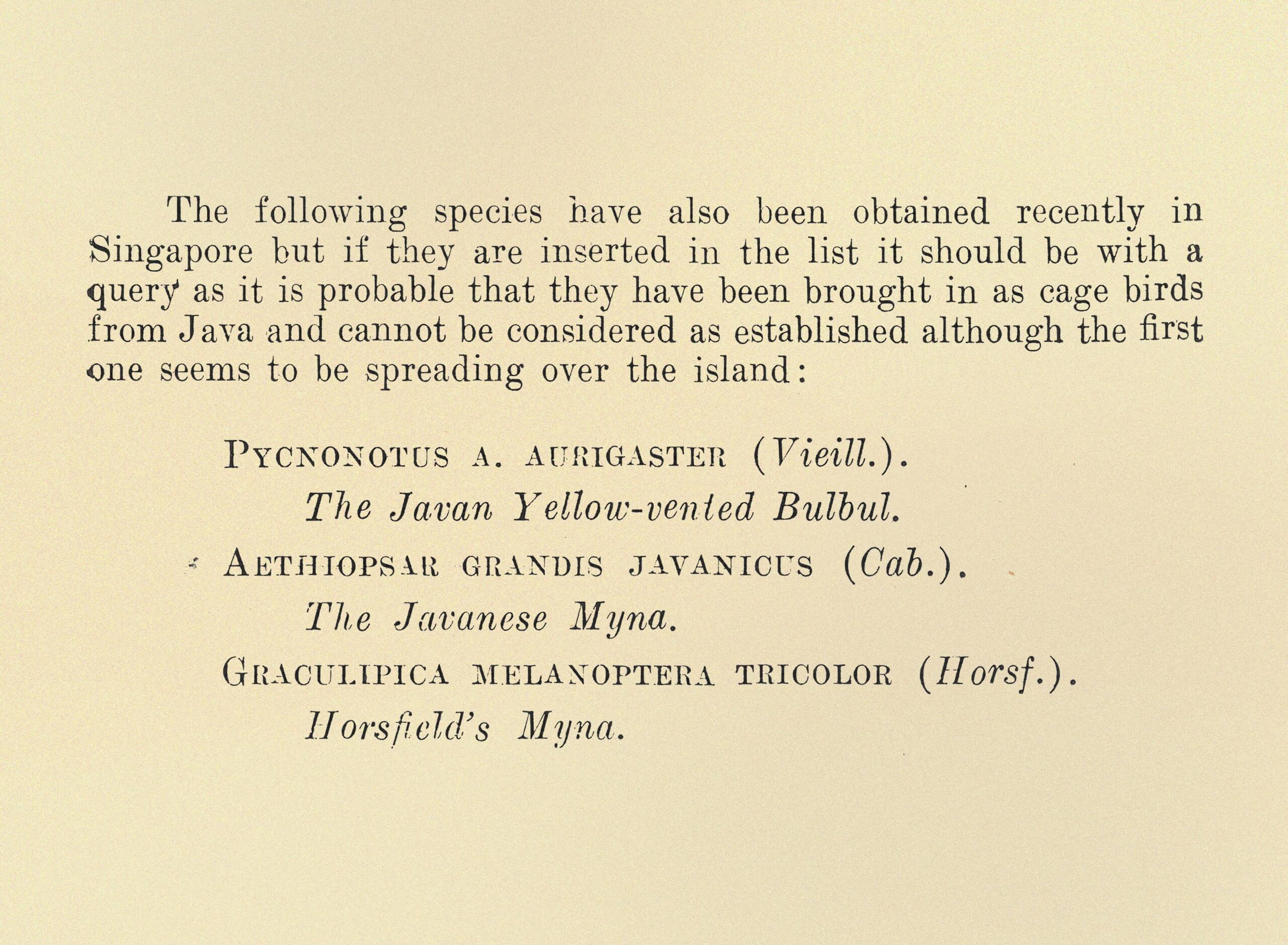
An excerpt from Birds of Singapore Island (1925), by Frederick Nutter Chasen.[
An excerpt from Birds of Singapore Island (1925), by Frederick Nutter Chasen.
By the 1950s, the Javan myna population had grown noticeably more abundant. In a 1950 article titled Myna Matters, written by Carl Alexander Gibson-Hill, then curator at the Raffles Museum, it is stated that the bird was “plentiful on the outskirts of the town and semi-garden areas further afield”. In particular, he also pointed out that the birds had become more common in the Tanglin area.

Specimens were even collected on the grounds of the Raffles Museum. Many of these specimens were preserved as so-called study skins (as can be seen in the specimens photographed for this article). Such a pose optimises museum storage space, while keeping important traits visible for researchers to study them.
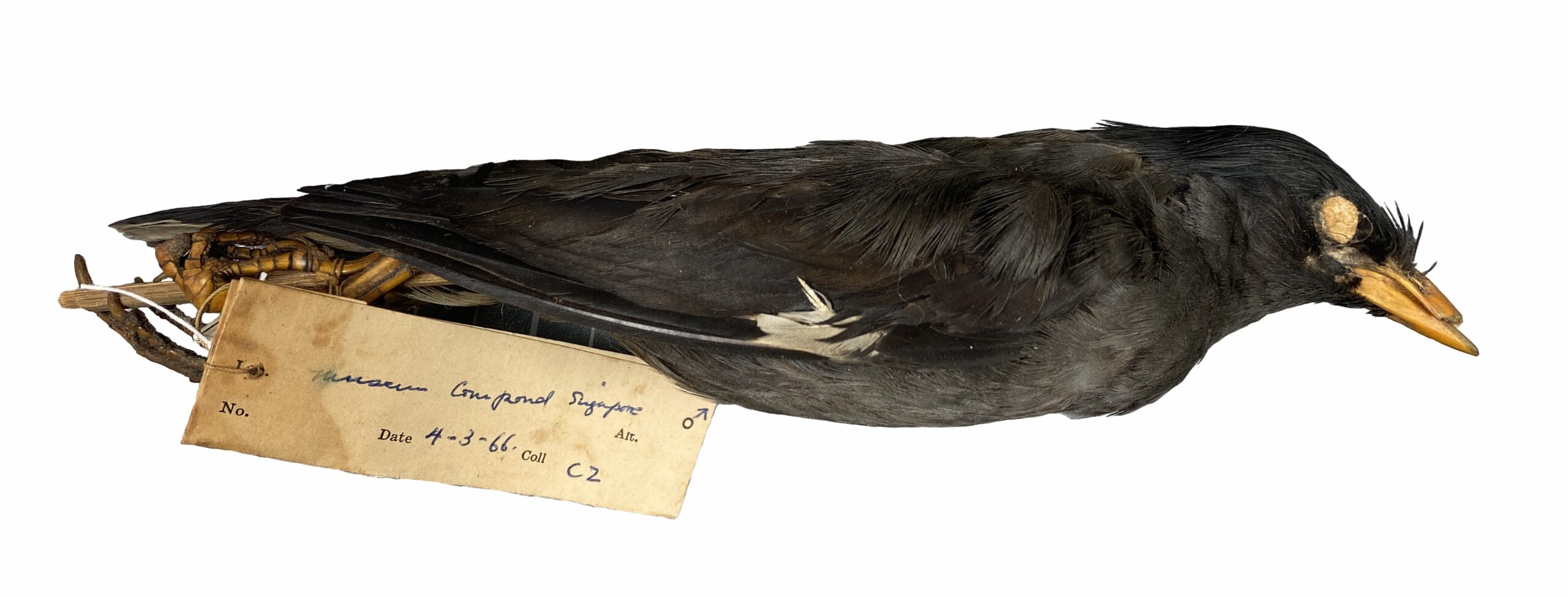
A male Javan myna collected from the grounds of the Raffles Museum in 1966 (Credit: Kathy Poh, Lee Kong Chian Natural History Museum).

From a Caged Songbird to a Bold City Dweller

By the mid-1980s, the Javan myna population in Singapore surpassed that of the common myna (Acridotheres tristis), which was once locally more abundant. This shift likely happened because the Javan myna—as bold and highly opportunistic scavengers—adapted extremely well to the increased urban spaces in Singapore during this period.
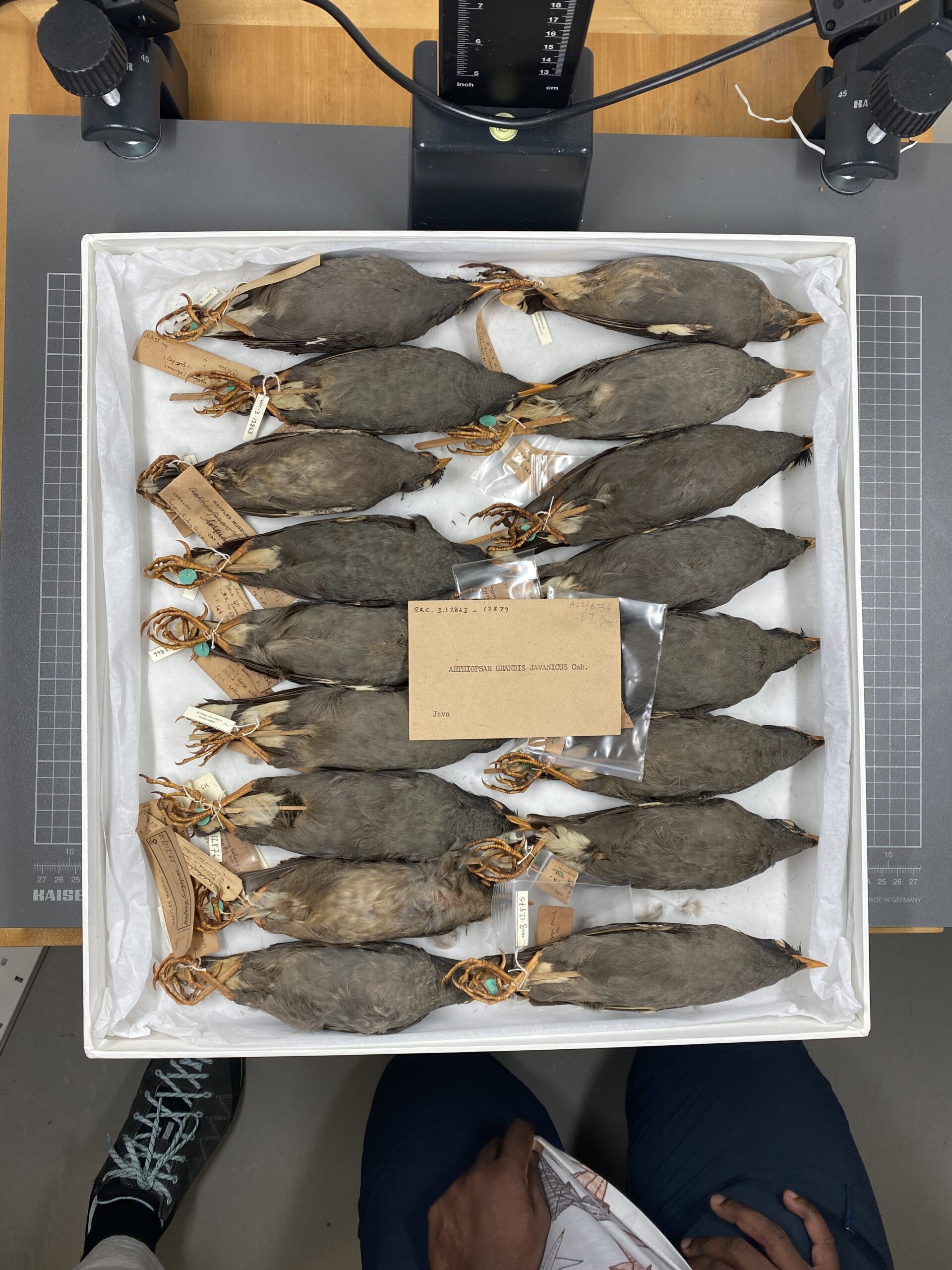
Javan myna specimens housed in the Lee Kong Chian Natural History Museum (Credit: Kathy Poh, Lee Kong Chian Natural History Museum).

Even though they are one of Singapore’s most common bird species today, every Javan myna specimen is a valuable part of our collections. Each specimen serves as a snapshot, marking where and when an individual of a species has been found. By looking at numerous specimens across time, we can understand the historical presence of a species in a certain place. In this case, we also uncover the story behind one of the most prolific urban adaptations in Singapore’s natural history.


Written by Kathy Poh and Jeslynn Teo

Sources

  1. Chasen FN (1925) Birds of Singapore Island. The Singapore Naturalist, 1(5): 71–73.
  2. Gibson-Hill CA (1950) Myna matters. Malayan Nature Journal, 5: 58–75.
  3. Ward P (1968) Origin of the Avifauna of Urban and Suburban Singapore. Ibis, 110(3): 239–255.
  4. Chong KY, Teo S, Kurukulasuriya B, Yi FC, Rajathurai S, Hwa CL & Tan HTW (2012) Decadal Changes in Urban Bird Abundance in Singapore. The Raffles Bulletin of Zoology, supp. 25: 181–188.
  5. Low GW, Chattopadhyay B, Garg KM, Irestedt M, Ericson PGP, Yap G, Tang Q, Wu S & Rheindt FE (2018) Urban landscape genomics identifies fine-scale gene flow patterns in an avian invasive. Heredity, 120: 138–153.