

A new freshwater fish species, the saddle barb (Barbodes sellifer) has been recently identified in Singapore! However, unlike other discoveries where new species are often found due to its rarity, this finding, was actually a case of mistaken identity.
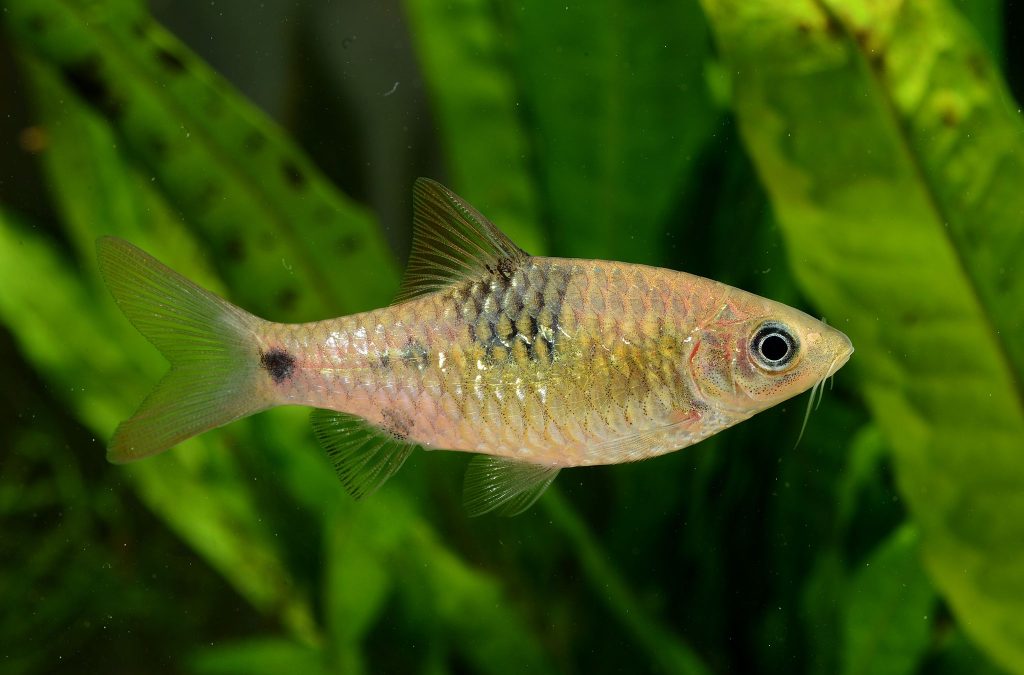
For decades, the Barbodes binotatus freshwater fish species, commonly known as the spotted barb or common barb, was thought to have varying colour patterns that differ across regions. To distinguish among them, names were given according to the regions that the populations appeared to be found. Puntius binotatus banksi, for instance, was the name given to the population with a dark bar under the dorsal fin that occurs in Peninsular Malaysia, Singapore and Sarawak. In 2013, however, research showed that this group actually had variations which were distinct enough to be considered its own species–B. banksi.
Yet, Mr Kelvin Lim, Curator of Vertebrates, and freshwater fish expert Dr Maurice Kottelat from Switzerland, knew something was still amiss. After a re-examination of this group, the pair’s latest study unveils two new species–B. sellifer and B. zakariaismaili even from within the B. banksi group, based on over 500 specimens collected in the museum.
The pair found that these three groups occur in more specific areas across the same region.
B. zakariaismaili occurs in the Jelai branch of the Pahang River basin in Peninsular Malaysia while B. sellifer is more widespread, ranging from Singapore, Peninsular Malaysia, central eastern Sumatra and the Riau, Anambas and Natuna Islands of Indonesia, said Mr Lim.
The original B. banksi appears to be restricted to Borneo, and the original B. binotatus to the Java island of Indonesia, he added.
So how did they tell the difference?
“Through their morphological traits”, says Mr Lim, with colour patterns and body shape as being their main distinguishers.
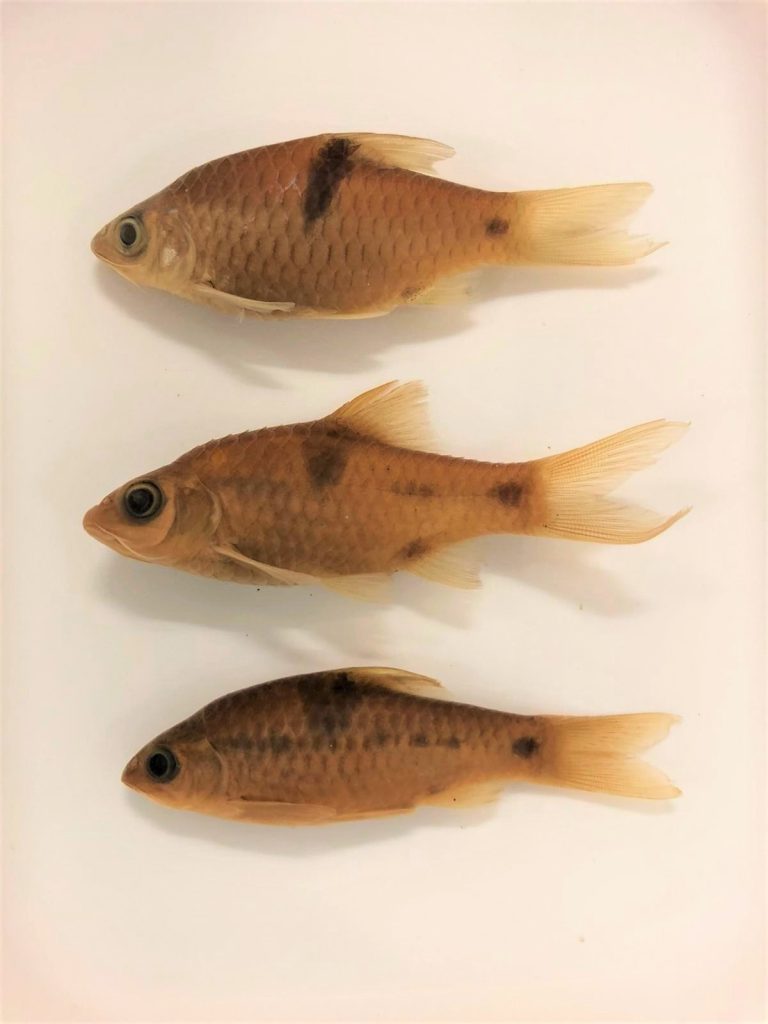
For instance, B. sellifer has a larger triangular-to-rectangular dark blotch beneath the dorsal fin (shown more distinctly in Fig 1)—a characteristic which probably led to its name ‘sellifer’, a Latin adjective meaning ‘bearing a saddle’. B. zakariaismaili, on the other hand, has a slender body with a narrower dark bar beneath the dorsal fin and a dark stripe on the front part of its body. The original B. banksi has a narrow black bar on its sides beneath the dorsal fin.
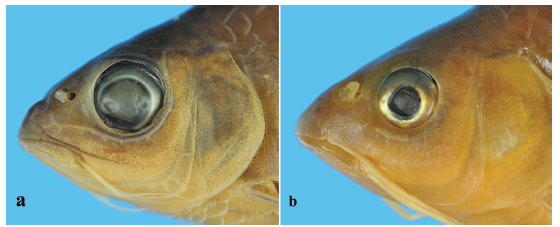
On closer inspection, one would also notice that there is an apparent distinction between the shape of the snouts of B. sellifer and B. zakariaismaili as well as the size of their eyes as shown below.
Six Barbodes species in Singapore
This discovery means that Singapore now has six species under the Barbodes group, with B. sellifer being previously misidentified as B. banksi. In addition, we also have the spanner barb (B. lateristriga), the Indochinese spotted barb (B. rhombeus) [also previously known under the B. binotatus group], the green barb (B. semifasciolatus) and the Malayan clown barb (B. dunckeri) [now believed to be extinct in Singapore].
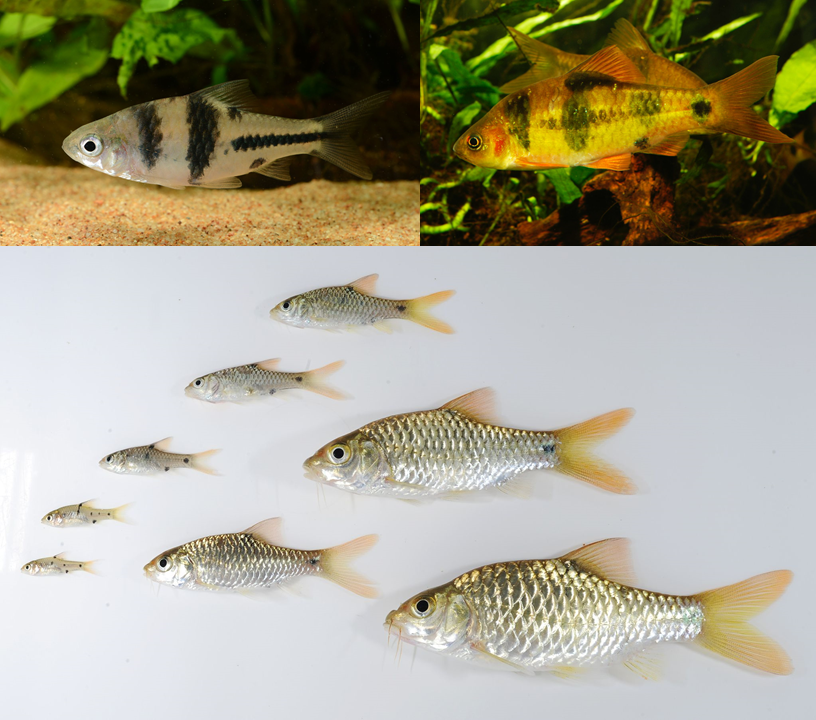
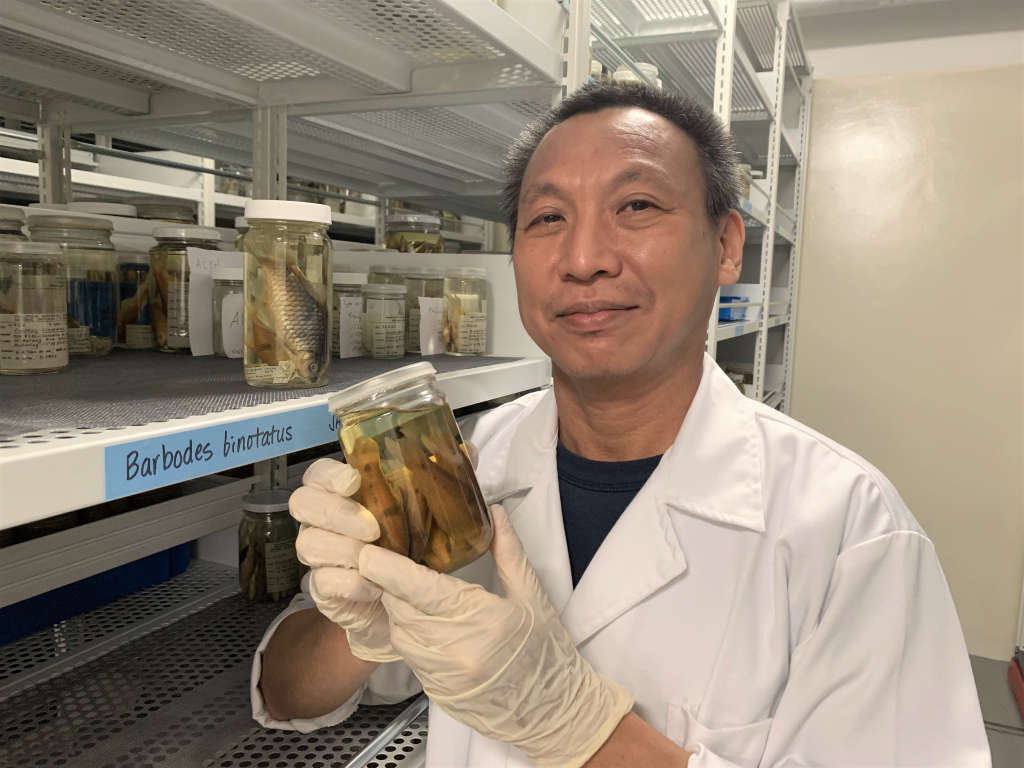
The B. binotatus group is “simply a taxonomically difficult group,” the study concludes, which was published in December last year in our Raffles Bulletin of Zoology journal.
New Discovery will advance Conservation Efforts
“The discovery of B. sellifer in Singapore’s Nee Soon Swamp Forest will help to boost its scientific significance and therefore its conservation value,” says Mr Lim.
The Nee Soon Swamp Forest is located to the southeast of the Central Catchment Nature Reserve, near the Seletar Reservoir, and is known to be the last substantial pocket of freshwater swamp forest in Singapore. Its unique habitat supports a rare and rich biodiversity of species which have developed interesting adaptations in the face of an ever-changing water environment. It is also known to be the only home for the endangered Swamp Forest Crab which was discovered by our very own Prof Peter Ng, Head of LKCNHM, in 1989.
—
Read the full paper from our Raffles Bulletin of Zoology here.
Find out more on The Straits Times here, along with other Freshwater Fish discoveries in Southeast Asia by Curator of Ichthyology, Dr Tan Heok Hui, here. Note: Both articles are for ST subscribers only.